

The most powerful weapon against breast cancer is early detection. When a tiny focus of a few millimetres that cannot yet be felt is caught by screening, recovery is often possible with a smaller operation and a lighter treatment programme. So when should screening start, and which test is right for whom?
Screening is not the same as diagnosis
Screening is regular testing in people without symptoms. If you feel a lump, have nipple discharge or a skin change, the work-up is a diagnostic evaluation, and it should be done immediately rather than waiting for a scheduled date.
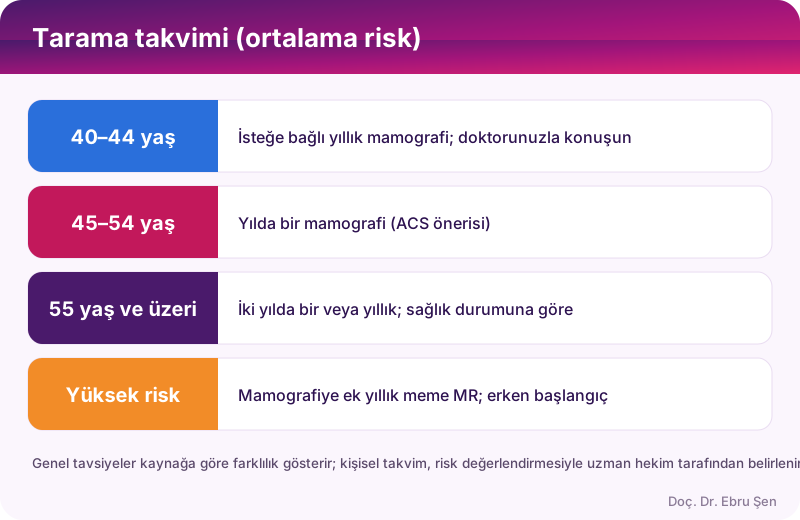
For women at average risk
According to American Cancer Society (ACS) recommendations, for women at average risk:
- Ages 40–44: women who wish to may start annual mammography.
- Ages 45–54: annual mammography is recommended.
- Age 55 and over: may switch to a mammogram every two years, or continue annually.
- Screening continues as long as overall health is good and life expectancy is at least 10 years; there is no fixed “stopping age”.
What does each test do?
| Test | Strength | Limit |
|---|---|---|
| Mammography | The only screening method shown on its own to reduce deaths; detects microcalcifications | Less sensitive in dense breast tissue |
| Breast ultrasound | Extra information in dense breasts; separates cystic from solid lumps | Not a screening method on its own; more false alarms |
| Breast MRI | Highest sensitivity; added to mammography in high-risk women | Costly; more false positives |
| Clinical examination | A specialist evaluates findings | Does not replace screening |
Who is at high risk?
This group includes women with a known BRCA1/BRCA2 change, women whose first-degree relative carries one but who have not been tested, women who had chest radiotherapy between ages 10 and 30, and women whose calculated lifetime risk is high. In these women, annual breast MRI in addition to annual mammography is usually recommended, starting at an earlier age.
Dense breast tissue
Dense breasts look white on a mammogram, and cancers also look white, so they can be “masked”. Density is not a disease and is very common, but together with a slight increase in risk it means you should discuss with your doctor whether extra imaging (ultrasound or MRI) is needed.
In summary
A screening schedule should be personalised not only by age but by family history, genetic status and breast structure. If you are unsure about your plan because of your age, family history or a current finding, you can build your plan together with a breast surgeon.

Doç. Dr. Ebru Şen
General surgeon whose area of interest is breast surgery. Sees patients at Istinye University Medical Park Gaziosmanpaşa Hospital and Başakşehir Çam and Sakura City Hospital.