
A significant share of breast cancers are found when women notice a change in their own breasts. Current advice puts the emphasis less on a rigid monthly ritual and more on breast awareness: knowing how your breasts normally look and feel, and seeing a doctor straight away when something changes.
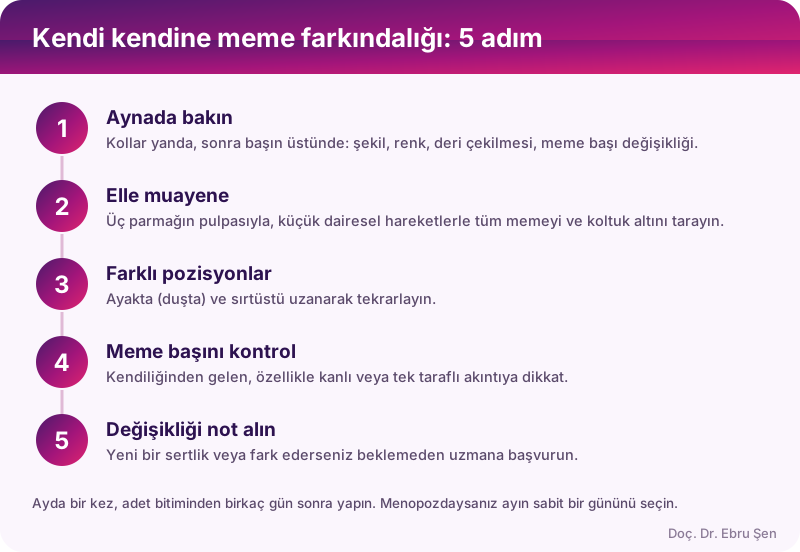
When to do it
For women who have periods, a few days after the period ends, when the breasts are softest and least tender. After menopause, pick a fixed, easy-to-remember day each month.
What to look for
- A new, hard, painless or fixed lump in the breast or underarm
- A one-sided change in breast size or shape
- Pulling or dimpling of the skin (orange-peel look), redness
- Nipple retraction, crusting, sores, or spontaneous, especially bloody discharge
- Swelling in the underarm
I found something; should I panic?
No. The great majority of lumps found in the breast are benign (cysts, fibroadenomas, fibrocystic change and so on). But which is which can only be told by examination and imaging. When you notice a change, do not delay with “let me wait for my period” or “let me watch it a bit longer”; see a breast surgeon.
Common mistakes
- Squeezing the nipple to check for discharge (it causes unnecessary discharge)
- Looking only at the centre of the breast and skipping the underarm and collarbone area
- Noticing a finding but not seeing a doctor out of fear

Doç. Dr. Ebru Şen
General surgeon whose area of interest is breast surgery. Sees patients at Istinye University Medical Park Gaziosmanpaşa Hospital and Başakşehir Çam and Sakura City Hospital.