

The question “Why did this happen to me?” often has no single answer. Breast cancer arises from several factors coming together; in many patients no clear cause can be found. Even so, knowing the risk factors is valuable both for planning screening and for lifestyle choices.
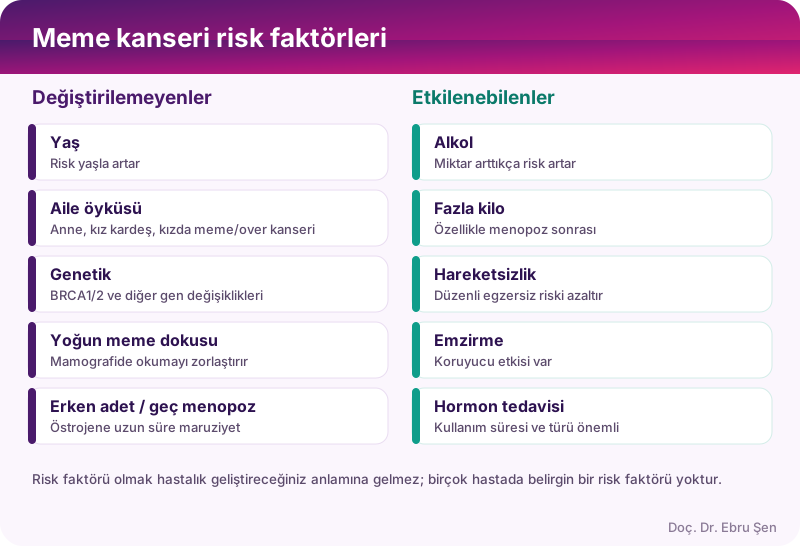
Factors that cannot be changed
- Being a woman, and age: risk rises with age; most diagnoses are made after 50.
- Family history: breast or ovarian cancer in a first-degree relative (mother, sister, daughter) increases risk.
- Genetic changes: the best known are BRCA1 and BRCA2; also genes such as PALB2, TP53, CHEK2.
- Dense breast tissue and a history of some benign breast conditions (such as atypical hyperplasia).
- Hormonal span: early periods and late menopause mean a longer exposure to oestrogen.
Factors we can influence
- Alcohol: alcohol, like several other cancers, is linked with breast cancer, and the risk rises as the amount increases. There is no “safe” lower limit; cutting down reduces risk.
- Excess weight: especially after menopause, risk rises because of oestrogen produced by fat tissue.
- Physical activity: regular activity lowers risk both before and after menopause. At least 150 minutes of moderate activity a week is recommended.
- Breastfeeding: a slight protective effect is seen as total breastfeeding time lengthens.
- Menopausal hormone therapy: especially oestrogen-plus-progestogen combinations may raise risk; the reason for use and its duration should be reviewed with your doctor.
- Smoking: shown to be harmful for breast cancer too, and should be stopped for general health.
What is knowing your risk good for?
In women at high risk, a surveillance plan can be made that starts at an earlier age and includes MRI; genetic counselling and, if needed, preventive options can be discussed. If risk is low, keeping up the screening schedule is still important: the great majority of women with breast cancer have no clear risk factor.

Doç. Dr. Ebru Şen
General surgeon whose area of interest is breast surgery. Sees patients at Istinye University Medical Park Gaziosmanpaşa Hospital and Başakşehir Çam and Sakura City Hospital.