

After a diagnosis, one of the most common questions is: “Which stage am I?” Stage summarises how far the disease has extended in the body, but on its own it does not say how well or badly things will go. The treatment plan is made according to stage together with the biological features of the tumour.
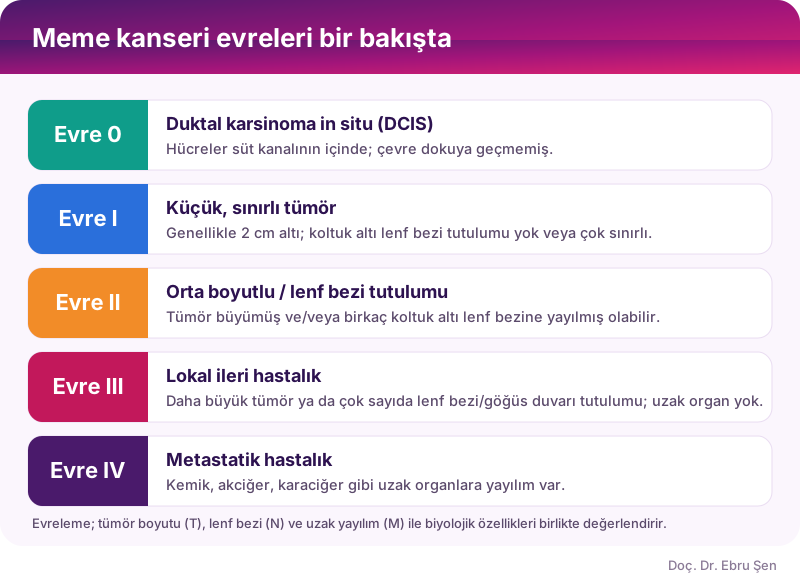
The TNM system: three questions
- T (tumour): How large is the tumour, does it reach the skin or chest wall?
- N (nodes): Has it spread to the underarm or nearby lymph nodes, and how many?
- M (metastasis): Has it spread to distant organs such as bone, lung, liver or brain?
Clinical and pathological stage
The clinical stage determined by examination and imaging before surgery may change into the pathological stage finalised by the pathology report after surgery. A difference between the two is normal; the pathological stage is the one that is binding.
Stage groups
- Stage 0 (DCIS): non-invasive disease confined within the duct.
- Stage I–II: early stage. Treatment usually starts with surgery; breast-conserving surgery is often possible.
- Stage III: locally advanced disease. Systemic treatment (such as chemotherapy) is usually planned before surgery.
- Stage IV: spread to distant organs. The aim is to keep the disease under control and to improve length and quality of life; with modern treatments many patients live for many years.
How is the treatment plan shaped?
Stage determines the timing and extent of surgery; the biological subtype determines the need for hormone therapy, targeted therapy or chemotherapy. Decisions must be made in a multidisciplinary board that includes a breast surgeon, medical oncologist, radiation oncologist, pathologist and radiologist.
Questions to ask
- What are the subtype and grade in my pathology report?
- Surgery first, or treatment first?
- Which approach is suitable for my lymph nodes?
- Is genetic testing needed?

Doç. Dr. Ebru Şen
General surgeon whose area of interest is breast surgery. Sees patients at Istinye University Medical Park Gaziosmanpaşa Hospital and Başakşehir Çam and Sakura City Hospital.